The cash-based physical therapy model is one of the cleanest in healthcare. No insurance contracts. No billing delays. No clawbacks. The patient pays at the point of service, the margin is high, and the relationship is direct. These are genuine structural advantages. They also create a structural ceiling that most cash-based PT owners hit and never break through.
The Economics of Cash-Based PT and Why the Ceiling Exists
A solo cash-based PT with full scheduling can realistically generate $180K to $350K per year.[1] The number varies with session pricing, visit volume, and cancellation rate. At $175 per session and 25 patient contacts per week, that is roughly $227K in annual gross revenue. It sounds strong until you run the math on what it takes to grow beyond it.
The ceiling is not market demand. In most markets, there is far more demand for excellent cash-pay PT than there are practitioners to provide it. The ceiling is hours. One human has a fixed number of treatment hours per week. When those are full, revenue stops growing unless the model changes. That change requires decisions most solo practitioners are not prepared to make.
See more on the specific revenue ceiling dynamics in Why Your Cash-Based PT Practice Hits the Same Revenue Ceiling Every Year.
What Breaks When You Add a Second Clinician
Adding a second clinician is the most common attempt at breaking the ceiling. It creates three new problems that owners are not expecting. First, the revenue per hour drops because a new clinician is not yet efficient and the owner is spending time supervising instead of treating. Second, the owner becomes a de facto practice manager without any practice management infrastructure. Third, the patient experience becomes inconsistent because the second clinician does not deliver care the same way.
None of these problems are unsolvable. They are all predictable. Owners who add staff before building systems end up with two or three clinicians, a management headache, and less personal income than they had as a solo practitioner. The answer is to build the infrastructure before making the hire, not after.
Pricing Architecture for Cash-Pay Practices
Most cash-based PT practices have a single pricing lever: the per-session rate. That is not a pricing architecture. A pricing architecture includes entry-level offers, care plan packages, recurring membership structures, and high-value intensive options. It creates a path for patients to enter the practice at the right level and move through a value ladder over time.
The average cash-based PT session in 2026 runs $150 to $250 depending on market and specialization.[2] Sports-focused practices in major metros can push $200 to $300 per session without resistance. The pricing is justified by outcomes and experience, not by hours spent. Practices that compete on price in cash-pay markets are building the wrong thing.
Care plan packages: a fixed number of sessions at a package price: increase revenue predictability and reduce no-shows. A 12-session package priced at $1,800 ($150 per session) in a market where the standard rate is $175 creates a perceived value proposition while improving cash flow and commitment. The operational impact alone justifies the structure.
The CAC Problem in a Cash-Pay Market
Patient acquisition in a cash-pay PT practice is harder than in an insurance-based practice because the patient is making a discretionary spending decision. Insurance patients go where they are directed. Cash patients go where they are convinced. That means acquisition requires more deliberate effort and produces a higher cost per new patient.
Estimated CAC for cash-based PT ranges from $150 to $300, depending heavily on whether the practice has built a referral engine or is relying on paid channels.[3] The most efficient acquisition in cash PT is a structured physician and provider referral program. When a sports medicine doctor, orthopedic surgeon, or primary care physician sends patients consistently, CAC approaches zero. Most practices have informal referral relationships. Almost none have a system.
The full CAC benchmarks by practice type are covered in detail in a separate article. The key point here is that a $200 CAC on a patient with a $2,400 LTV (a 12-session care plan plus one follow-up package) is excellent. Without that LTV context, the CAC number is meaningless.
Retention and Recurring Revenue Models
Cash-based PT historically has an episodic revenue model: patient comes in with a problem, completes a care plan, and leaves. That model has no revenue floor. Every month starts at zero. The practices that scale past $600K are the ones that build a recurring revenue component into the model.[3]
Recurring revenue in PT takes two primary forms: performance memberships and maintenance programs. A performance membership for athletes: monthly access to sessions, movement screens, and programming: at $200 to $400 per month creates a stable revenue base. A maintenance membership for post-episode patients: quarterly check-ins and one session per month: at $150 to $200 per month holds patients in the practice between episodes.
Twenty recurring patients at $250 per month is $5,000 per month in guaranteed revenue.[2] That changes the financial profile of the practice completely. It is not a replacement for episodic revenue. It is a foundation that makes everything else more predictable.
The Org Design Transition: Solo Practitioner to Practice Owner
The hardest shift in a cash-based PT practice is not operational. It is psychological. The solo practitioner's identity is bound up in patient care. Moving into a practice owner role means treating less and building more. Most DPTs resist this. Those who do not resist it are the ones who build something worth owning.
The transition happens in stages. First, the owner builds systems so that clinical delivery is documented and replicable. Second, the owner hires and trains a second clinician against those systems. Third, the owner begins moving clinical hours to management and development functions. Fourth, the practice can grow without the owner's treatment hours as the primary constraint.
This is the path. It requires a different skill set than clinical excellence. It requires operator skills: strategy, finance literacy, team building, and systems design. The Force Multiplier scaling framework addresses that transition directly.
The Path Through: What Actually Breaks the Ceiling
The ceiling is structural. The solution is also structural. It does not come from seeing more patients or charging $25 more per session. Here is what it looks like in practice.
Group Classes Change the Math Immediately
The group class model is the fastest lever a solo PT can pull without hiring. Six to ten people per session at $79 each. One PT, one hour. At eight people, that is $632 in revenue. Compare that to a single patient at $150 to $200. The same hour produced $432 to $482 more. One group class per week added to an existing schedule produces $32,000 to $33,000 in additional annual revenue. Two per week approaches $66,000. None of this requires double-booking or running a patient rushed through a 45-minute slot.
The formats that work: postpartum recovery and mommy-infant mobility classes for new mothers, AARP-focused mobility and balance sessions for older adults on evenings and Saturdays, sports performance and conditioning groups for endurance athletes, and WFH posture series for remote workers dealing with neck, back, wrist, and shoulder issues. Each of these has a specific community that already exists. The PT is not inventing demand. They are showing up where demand already lives.
The Telehealth Hybrid Model
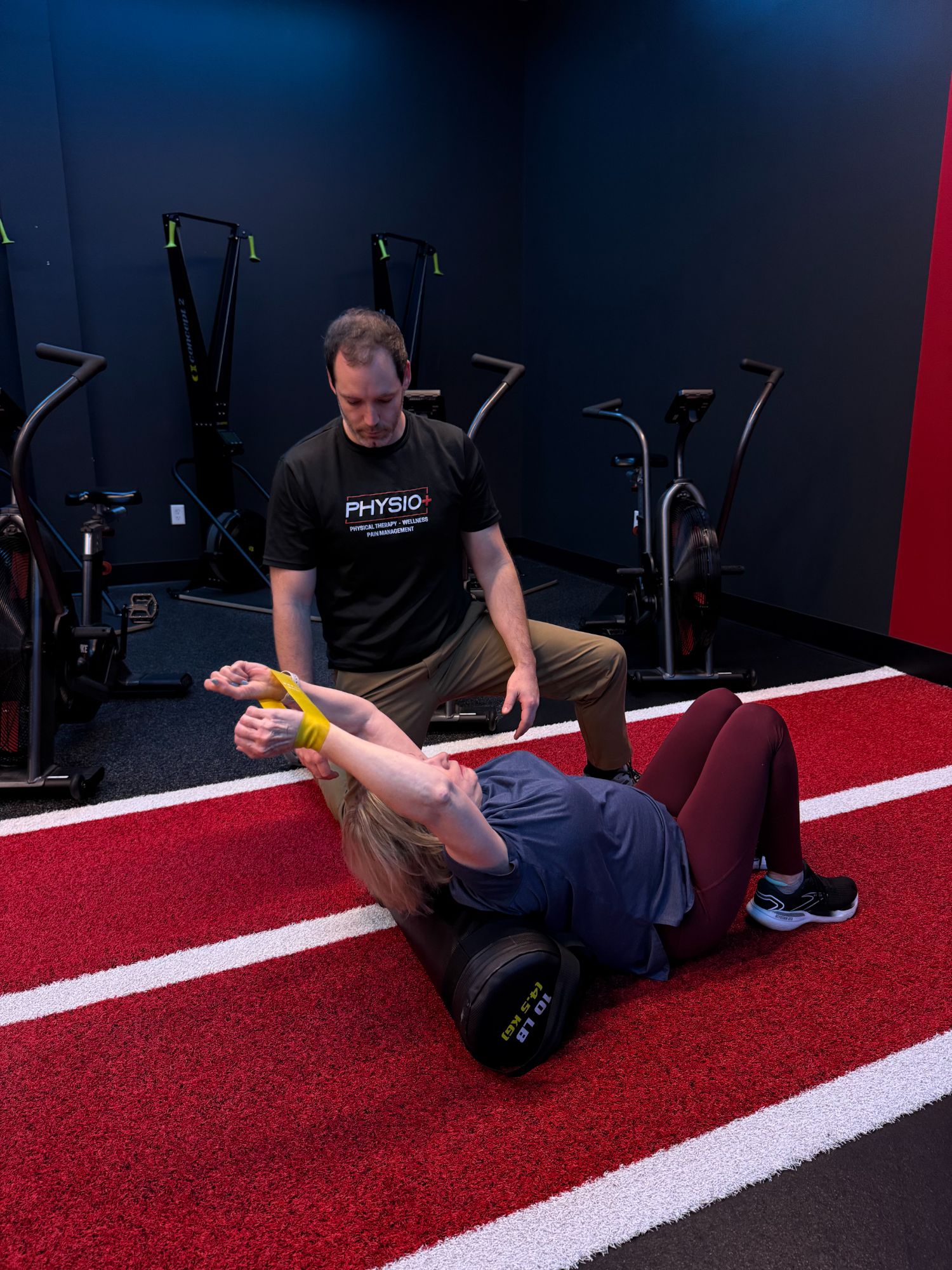
Physio+ is already running this model at scale. The structure: a $49 per month app subscription where the PT uploads and manages the patient's programming, one physical visit per month included at $95, and quick 10 to 15 minute telehealth check-in calls for form checks, pain management questions, and reassurance. Four of those calls fit in one hour.
The patient gets continuous access, value between visits, and the relationship they came for. The PT gets recurring revenue that does not disappear when a patient has a chaotic week and skips their in-person visit. Fifty patients on a $49 monthly subscription is $29,400 per year in revenue that arrives whether or not every patient showed up for every session. That is not a replacement for episodic revenue. It is a floor that changes the financial profile of the entire practice.
Recurring Memberships vs. Episodic Revenue
Life gets in the way. A patient has a work emergency, a sick kid, a travel conflict. Under the episodic model, that missed session is lost revenue. It cannot be recovered. The month starts at zero and the missed slot stays empty.
Under a membership model, the PT gets paid whether or not the patient attended every session. The patient pays for ongoing access to a wellness structure, not for individual visits. This is not a technicality. It is a fundamentally different financial relationship. The membership is designed for ongoing wellness, not episodic treatment. Patients who are on memberships stay engaged longer, refer more often, and represent a stable revenue base the practice can plan around. Every additional membership member raises the financial floor of the practice by their monthly amount, permanently.
Niche Verticals That Build Word of Mouth
Four verticals produce the fastest community-driven growth in cash-based PT right now. Postpartum recovery: the market of new mothers seeking pelvic floor recovery, early movement, and community support is large, growing, and refers aggressively. A Saturday morning mommy-infant class at a local park can seed a practice in under 90 days. AARP and older adults: group mobility and balance classes, evenings and weekends, built around the hours this demographic is actually available. The group format builds familiarity and retention fast. WFH remote workers: posture correction, neck and back pain, wrist and shoulder issues from poor desk ergonomics. This group is online, searching for answers, and underserved by traditional PT. Content marketing: chair setup guides, femur-length and seat-height explanations, corrective exercise breakdowns: builds the brand and generates the assessment bookings. Sports performance: summer 6-week training camps for high school and college endurance athletes, $497 per athlete, group format, 10 athletes per camp. Two camps per summer adds close to $10,000 with minimal overhead.
The common thread is specificity. Each of these communities already exists in most geographies. The PT does not create the demand. They identify the community, build the offer around it, and let word of mouth do the heavy lifting.
The path from the $180K to $218K solo ceiling to $350K and beyond is not more hours. It is the same hours, restructured. Add two group classes per week: $65,000. Add a 50-person app subscription: $29,000. Add one summer performance camp: $5,000. That is $99,000 in additional annual revenue on top of the existing solo schedule without a second full-time therapist. Every model above has been implemented in active practices. None of them require a hire to start.
SOURCES
[1] APTA Private Practice Section, “Cash-Based Practice Benchmark Report,” 2025, https://www.aptapps.org/resources
[2] Physical Therapy Journal (PTJ), “Scaling Models for Independent Physical Therapy Practices,” 2024, https://academic.oup.com/ptj/pages/about
[3] Kauffman Foundation, “Growth Dynamics of Health Service Microbusinesses,” 2024, https://www.kauffman.org/entrepreneurship/research/